






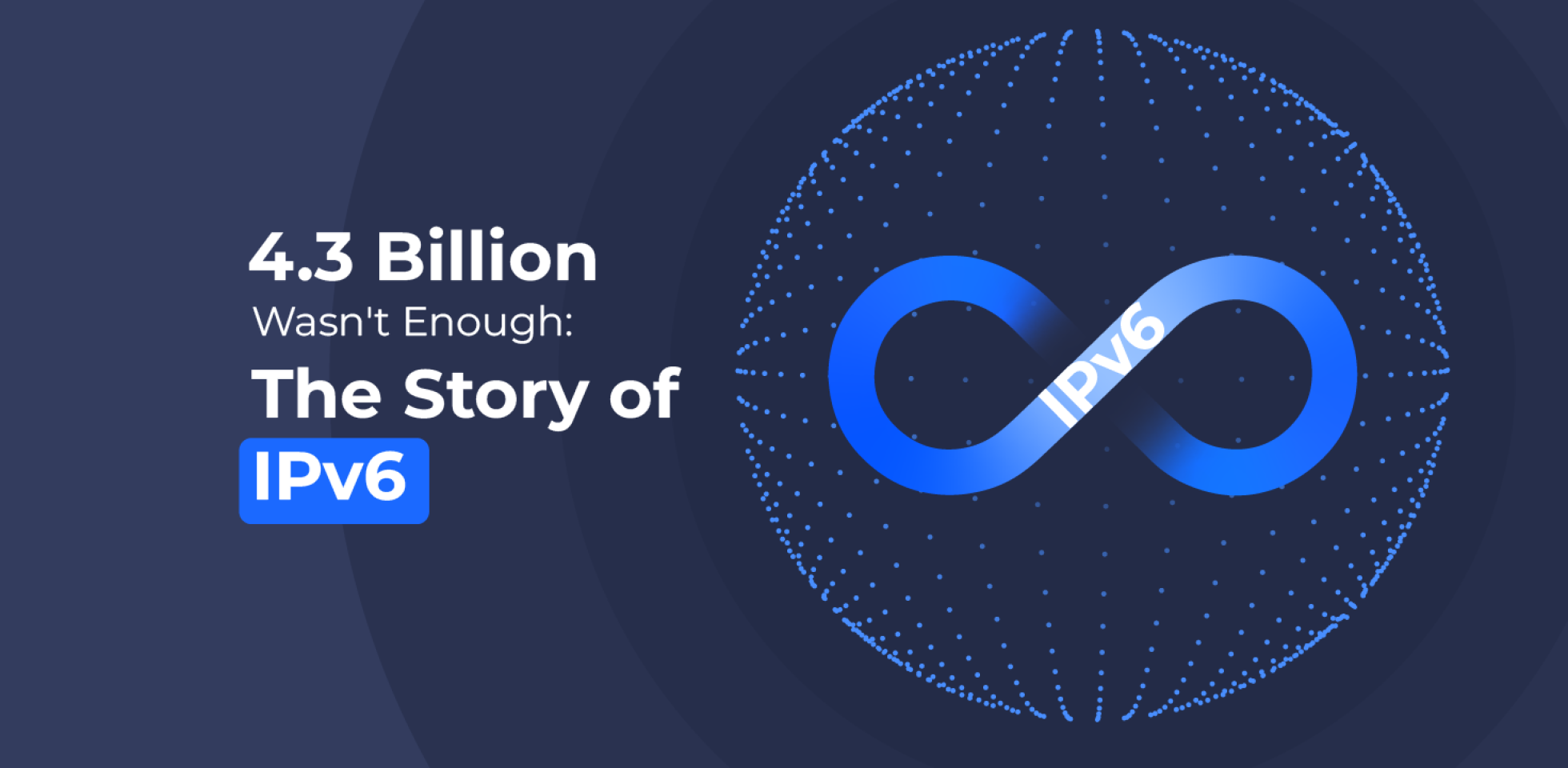
4.3 Billion Wasn’t Enough: The Story of IPv6

Right now, as you read this, billions of devices are quietly fighting over a resource the internet ran out of years ago. Your phone, your laptop, the smart TV, all of them need something to exist online. And the world simply doesn’t have enough of it anymore.
That “something” is an IP address. Back in the early days of the internet, we thought we had so many we’d never run out. We were wrong by a staggering margin.
Every June 6th, the internet community marks IPv6 World Launch Day, the anniversary of the day the world’s biggest ISPs permanently switched on the technology built to fix this shortage. More than a decade later, IPv6 isn’t a future plan anymore. It’s the foundation the modern internet is quietly being rebuilt on. And yet plenty of businesses are still running on the old system alone, paying for it in rising costs and growing headaches.
So how did the internet paint itself into this corner, and what does it mean for you? Let’s start at the very beginning.
First, What Is an IP Address?
Every device that connects to the internet needs an address, the same way every house on a street needs one for the mail to arrive. That’s an IP address, short for Internet Protocol address. When you load a website, your device and that website’s server are really just two addresses passing data back and forth.
The system that makes this work, the Internet Protocol, grew out of research in the 1970s led by engineers Vint Cerf and Bob Kahn, often called the fathers of the internet. Their early versions went through a few iterations, and by the time the design settled in the early 1980s, it had reached its fourth version. That’s the one that went on to run the world: IPv4.
You’ve almost certainly seen an IPv4 address without knowing it. Ever typed 192.168.1.1 into a browser to log into your home router? That’s one. Four numbers, separated by dots, each between 0 and 255.
It looks simple. So why couldn’t it keep up?
When the Internet Hit a Wall
IPv4 was built for a small group of researchers, not for a planet. Nobody in 1983 imagined a world where everyone walks around with a supercomputer in their pocket.
The math tells the story. Those four numbers give IPv4 roughly 4.3 billion possible addresses. In the 1980s that sounded endless. But there are over 8 billion people on earth now, many carrying several connected devices each, plus the servers, sensors, cameras, and appliances that make up the modern internet.
We didn’t just get close to the limit. We blew right past it. By February 2011, the global pool of fresh IPv4 addresses was officially handed out, and the industry has been improvising ever since.
How do you keep a system running after it’s out of addresses? With a clever, and increasingly painful, workaround.
Think of It Like Phone Numbers
Here’s the simplest way to picture what happened next.
Imagine every IP address is a phone number. Once the world ran out of direct-dial numbers, the internet fell back on a trick called Network Address Translation, or NAT.
NAT works like an office phone system. You don’t get your own direct line. Instead, the whole building shares one main number, and you dial an extension to reach anyone outside. It was meant to be a temporary patch. It never left.
And it brings real problems with it:
- Costs keep climbing. IPv4 addresses have become a scarce commodity, openly bought and sold, with prices that have risen sharply year after year.
- Things break. NAT trips up video calls, online gaming, and other apps that need a direct connection between two devices.
- Users get a worse experience. Many ISPs around the world now stack hundreds of customers behind a single shared address, a practice called Carrier-Grade NAT. When a website or service breaks because of it, people blame the website, not their provider. Worse, if one user on that shared address misbehaves, the whole group can get flagged or blocked together.
The fix for all of this was already invented. But before we get to it, there’s a small mystery worth solving.
Wait, What Happened to IPv5?
If we jumped from IPv4 to IPv6, where’s IPv5?
There was an IPv5. Sort of. Back in the 1970s, engineers built an experimental protocol for streaming voice and video, and it claimed the “version 5” label for itself. It never went mainstream, but the number was already spoken for.
So when the true successor to IPv4 was finalized, version 5 was already assigned. Rather than reuse it, the designers gave the new protocol the next available number: 6.
No grand conspiracy. No tragic failure. Just a naming slot that someone got to first. Which brings us to the real star of the story.
Enter IPv6: Room for Everyone
IPv6 stretches the address space from 32 bits all the way to 128 bits. In plain terms, that takes us from 4.3 billion addresses to a number so large it’s effectively limitless: enough for every grain of sand on the planet, with vast amounts to spare.
The addresses look different too. Instead of a short string like 192.168.1.1, an IPv6 address is longer and uses letters and numbers, something like 2001:0db8:85a3::8a2e:0370:7334. It looks intimidating, but that extra length is exactly what gives us the near-infinite supply.
Size is only part of the story, though. IPv6 also brings:
- Self-configuring devices. A device can join a network and set up a valid address on its own, with no manual setup needed.
- Faster routing. A cleaner, more efficient header lets routers move data along more quickly.
- A real end-to-end connection. IPv6 restores the direct model the internet was originally designed around, instead of funneling everything through shared workarounds.
- Security from the ground up. Encryption and authentication were part of the design from day one, not bolted on later.
I’ll be honest with you. Switching to IPv6 won’t magically multiply your traffic or fix a badly written app. What it does is future-proof your infrastructure, while the cost of clinging to the old system keeps climbing.
But if your current setup still works, do you have to change everything overnight? Not at all.
The Golden Rule: You Don’t Have to Choose
There’s an old saying in IT: never touch a running system.
The good news is that IPv4 and IPv6 were designed to run side by side, peacefully, on the same network at the same time. This approach is called dual-stack, and it’s the key to a stress-free transition.
Think of it as a building that accepts both the old phone extensions and brand-new direct lines at once. Nothing you rely on today stops working. Older services keep reaching you over IPv4, while newer ones connect over IPv6, and your visitors never notice the difference. You get the benefits of the new system without gambling on the old one.
The smart move, then, is simple. From now on, every time you buy new hardware or upgrade software, make sure it’s IPv6-ready. Sorting it out gradually during your normal refresh cycles costs far less than scrambling to flip everything over under pressure later.
So where does that leave your business today?
How Libyan Spider Powers Your IPv6 Journey
IPv6 Enabled Across Our Infrastructure
At Libyan Spider, IPv6 support is a fundamental part of our modern infrastructure. We have fully enabled IPv6 across our network to ensure your services are ready for the modern Internet, improve accessibility for users worldwide, and provide a strong foundation for future growth.
Choose an infrastructure built for the future and start benefiting from the advantages of IPv6 today with Libyan Spider.
The Internet Already Upgraded
IPv6 World Launch Day is more than a date on the calendar. It’s a checkpoint. IPv4 ran out of room years ago, IPv5 was never more than an experimental footnote, and IPv6 is now the ground the global internet is building on.
The good news is that getting future-ready is straightforward when you’ve got the right partner, and there’s no better time to start than now.
So take a look at your company’s infrastructure and ask yourself one thing: are you building for 1995, or for 2035? Talk to the Libyan Spider team today and let’s get your business IPv6-ready.
Share:










Leave a Reply